
Articles
How to Assess Sleep in Therapy: Start With a Better Question
Start with how the client feels on waking, not how many hours they sleep. Ask whether, within a few minutes of getting up, they feel physically refreshed and cognitively sharp. If they say no or hesitate, assess further: check four everyday habits first, then look at the brain's own sleep rhythm, where neurotherapy can work alongside the therapy you already do.

Most of us know the sleep hygiene list by heart. A fixed wake time, morning light, caffeine early in the day, go easy on the wine, keep naps short. We share it, and for many clients it helps.
Then there is the client who has done all of it and still lies awake.
Why should every assessment include sleep?
In our clinical experience, every mental health assessment should include a careful review of sleep, because a client’s sleep affects not only many presenting problems but also their capacity to engage in treatment.
Sleep problems not only contribute to the challenges in living our clients face; they can also directly affect their capacity to engage effectively in their work with you. A client who is half asleep in session will struggle to take in even our best interventions. Yet many of us were trained to give sleep hardly more than a passing glance. Dr. Nathan Brown puts it plainly: “I went to a pretty good doctoral program in psychology, and we got about 15 minutes of training on the sleep cycle.”
Consider an executive in a high-stress role. He comes in wanting to improve a performance issue, such as inefficient decision-making. Only when asked directly does he acknowledge trouble both falling asleep and staying asleep. For him, as for many high-powered people, chronic insomnia feels normal, so he never suspects it might be behind his trouble with decisions.
What should I ask instead of “How many hours do you sleep?”
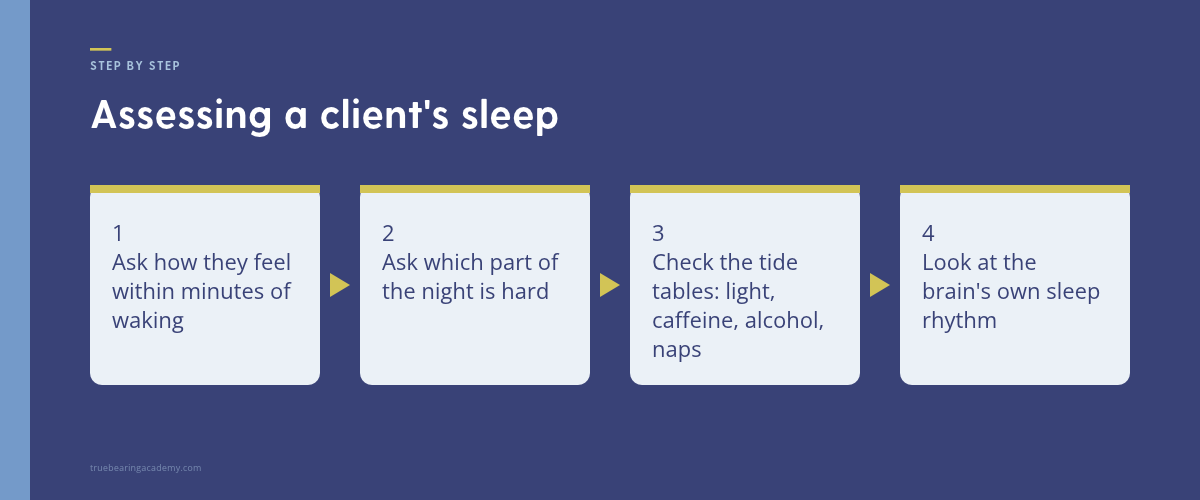
Ask how the client feels within a few minutes of getting up. The hours question invites a number, and a number says little about what the night did.
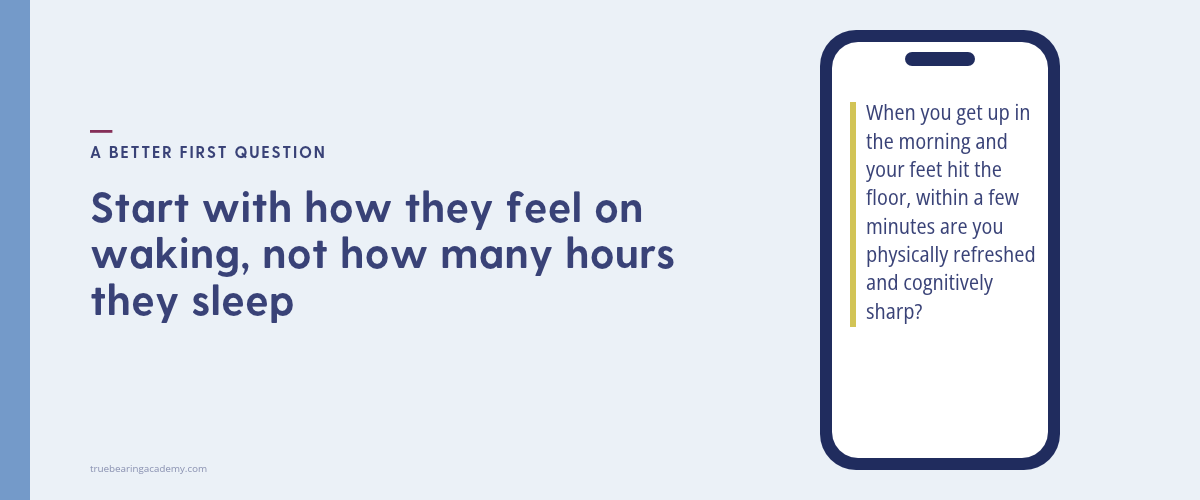
In Dr. Brown’s words: “The first question most clinicians ask is, ‘How many hours of sleep do you get each night?’ They’re looking for ‘8 hours’ or something like that. That’s the wrong question. The most useful question to start with is, ‘When you get up in the morning and your feet hit the floor, within a few minutes are you physically refreshed and cognitively sharp?’ If your client says no, or even hesitates in answering that question, consider that you have a sleep dysregulation to assess.”
The question works because it asks about what sleep produces. A good night restores the body and leaves the mind sharp. Deep, slow-wave sleep early in the night is tied most closely to physical rest and repair. Dream sleep, which lengthens toward morning, is tied more to cognitive processes. A no on either half of the question points back to something in the night.
The answer is still only part of the picture, the client’s own self-report, so treat it as the start of an assessment, not a definitive measure of sleep. Next, ask which part of the night is hard:
- Trouble falling asleep
- Trouble staying asleep
- Both
Clinicians call these sleep-onset, sleep-maintenance and mixed insomnia. From the brain’s point of view they are different problems, and they point to different approaches later on.
What should I check first?
Check the everyday habits that move sleep from underneath. Picture a sailboat. The sailor on the surface reads what can be seen: the wind, the waves, the clouds coming in. Those are the things a client can notice and tell you, like how tired or wired they feel.
But forty feet down, a current moves the boat whether the sailor feels it or not.
Two forces run underneath, and both have to run the same way for sleep to come easily.
- The current is sleep pressure, built up by adenosine across the waking day. Only sleep brings it down.
- The tide is the body clock, which decides when sleep is allowed.
Jet lag is what happens when they split. In Dr. Brown’s words, the same split happens “on an ordinary Tuesday, at a smaller scale.”
The tide tables: four everyday things that move the current and the tide
- Wake time and morning light. Morning light is the body clock’s main time signal, so a fixed wake time anchors sleep better than a fixed bedtime.
- Caffeine. It sits in the receptors adenosine would use, so pressure keeps building but the brain cannot read it.
- Alcohol. It can shorten the time to fall asleep, then the second half of the night comes apart as it wears off: lighter sleep and more waking.
- Long or late naps. A long nap late in the day spends the pressure the client needs at bedtime.
Consider a client who keeps good evening habits and still lies awake for up to two hours. If you listen carefully and ask about the day they had, you might discover that what keeps them awake at 11 p.m. is the hour-long afternoon nap at 3 p.m., which uses up the sleep pressure needed at bedtime. The nap may have begun as a way to cope with poor nights, and over time it became part of the problem. Cutting it to fifteen or twenty minutes, short enough to stay mostly in light sleep, leaves most of the day’s pressure for bedtime. For a client like this, that one change, eight hours earlier, can be all it takes.
What if sleep hygiene is not enough?
Sometimes the habits are in place and the nights still go badly. That is when it helps to look at the brain’s own sleep rhythm.
Good sleep depends on the brain moving through slower brain wave patterns across the evening and night:
- Alpha dominant in the hour or two before bed
- Alpha and theta dominant at the transition into sleep
- Deep delta-dominant sleep an hour or two after falling asleep
- Multiple cycles of 60 to 90 minutes that move from delta to theta and alpha and back, often associated with dreaming.
For some clients, the brain does not settle into that natural rhythm on its own.
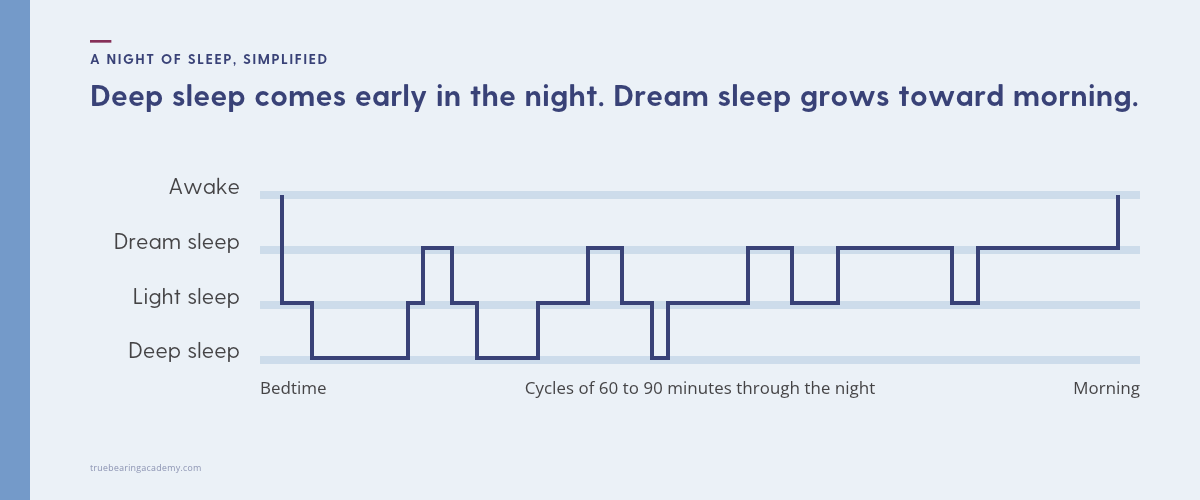
Each step prepares the next. Alpha is a relaxed, settled state, the doorway between waking and sleep. Theta carries the drift into sleep, which takes a few minutes to about half an hour in healthy sleepers. The early cycles of the night hold the most deep sleep; the later cycles hold more dream sleep.
How does neurotherapy work with sleep?
Neurotherapy tools can work most directly on these patterns, in two steps.
- Assessment, often beginning with EEG, shows whether the client’s brain is able to shift the relationship between certain slow and fast waves as bedtime approaches.
- Training, whether focused on brain patterns, vagal tone or muscle tension, then works to create the conditions for the brain to shift into the sleep-optimizing pattern it has evolved to produce.
For the executive described earlier, that included a short neurotherapy session at bedtime.
In clinical practice, neurofeedback for sleep has tended to follow three broad approaches: calming the nervous system overall, often by rewarding more alpha; strengthening low beta, or sensorimotor rhythm, the steady, mindful focus that can come before sleep; and strengthening the slow waves themselves, theta and delta, which the brain needs to fall asleep and to stay asleep. Which one fits depends on what assessment shows, and on whether the trouble is falling asleep, staying asleep or both.
Assessment also guards against a common misstep. In a brain short on slow waves, extra alpha may be the brain compensating. Training alpha up in that client can add to the problem, so check sleep first.
This is partnership work. CBT-I works most directly on the thoughts and habits that keep a client awake. Neurotherapy works most directly on nervous system function. Each strengthens the other.
For more on how the two work together, read Blending Neurotherapy with Psychotherapy and Coaching.
When should I refer, or use CBT-I?
Some signs call for a physician or sleep specialist:
- Loud snoring with gasps or pauses
- Legs that will not keep still at night
- Sleepiness that puts the client at risk on the road
- Insomnia that has gone on for months
And for some clients, poor sleep is driven more directly by ruminative thinking that overwhelms the normal sleep cycle. For them, we point to CBT-I as a primary strategy.
How sure are we?
Research-backed: sleep depends on two processes, sleep pressure and the body clock. Alexander Borbély described this model in 1982, and it has held up for more than forty years.
Research-backed: people feel less impaired than they are. In a study by Hans Van Dongen and colleagues, people kept on six hours of sleep a night for two weeks did steadily worse on attention tests, while their own sleepiness ratings rose a little and then leveled off.
Research-backed: caffeine later in the day matters. In a study by Christopher Drake and colleagues, 400 milligrams taken within six hours of bedtime measurably cut into the night’s sleep.
Emerging: neurofeedback for sleep has been studied, but often in combination with other methods, so its effect on its own is not yet clear. From a lab perspective, it is too early to draw firm conclusions. However, for decades neurotherapists have found that, as part of a customized plan, neurofeedback can play a crucial role in retraining the brain into the rhythms it has evolved to depend upon.
A deeper place to look
When a client has done everything on the list and sleep still will not come, the next step does not have to be another list. There is a deeper place to look, and neurotherapy gives you a way to see it and work with it, alongside the therapy you already do.
Adapted from Dr. Nathan Brown’s Headstrong post “The Current Forty Feet Down”.
Frequently asked questions
What is the best first question to ask a client about sleep?
Ask whether, within a few minutes of getting up, they feel physically refreshed and cognitively sharp. If the client says no, or even hesitates, consider that you have a sleep dysregulation to assess.
Is sleep hygiene enough for insomnia?
For many clients it helps, and it is worth checking first. When the habits are in place and the nights still go badly, look deeper: at ruminative thinking, where CBT-I is a primary strategy, and at the brain's own sleep rhythm, where neurotherapy can work alongside the therapy you already do.
What are sleep pressure and the body clock?
Sleep pressure builds up through adenosine across the waking day, and only sleep brings it down. The body clock decides when sleep is allowed. For sleep to come easily, both have to run the same way.
How does neurotherapy work with sleep?
In two steps. Assessment, often beginning with EEG, shows whether the client's brain is able to shift the relationship between certain slow and fast waves as bedtime approaches. Training then works to create the conditions for the brain to shift into the sleep-optimizing pattern it has evolved to produce.
When should a client see a physician or sleep specialist?
When there is loud snoring with gasps or pauses, legs that will not keep still at night, sleepiness that puts the client at risk on the road, or insomnia that has gone on for months.
To protect privacy, the clients described here are composites or have had identifying details changed. Every story is rooted in real experience.